Connected & Protected
24/7 Support
HomeBlogSecuring the Software Supply Chain: How SentinelOne’s AI EDR Autonomously Blocked the CPU-Z Watering Hole Cyber Attack
Company
#Company
#CPU-Z
#CPUID
#Supply Chain Attack
#threat report
#SentinelOne
#AI EDR
#CPU-Z watering hole attack
#software supply chain security
#cybersecurity threats
#malware detection
#behavioral analysis
#cyber attack prevention
#threat intelligence
#compromised software

Securing the Software Supply Chain: How SentinelOne’s AI EDR Autonomously Blocked the CPU-Z Watering Hole Cyber Attack

On April 9, 2026, cpuid.com was actively serving malware through its own official download button. Threat actors had compromised the CPUID domain at the API level and were silently redirecting legitimate download requests to attacker-controlled infrastructure. The attack ran for approximately 19 hours. Users who navigated directly to the official site received a legitimate, properly […]

S
SentinelOne
Content Author
Content Specialist

SentinelOne is a leader in autonomous cybersecurity solutions, specializing in advanced threat detection and response. With a focus on AI-driven technologies, they empower organizations to safeguard their digital environments against evolving cyber threats.

Expertise: Cybersecurity, AI-driven threat detection, software supply chain security, malware prevention, incident response
Published: May 2, 2026
Updated: May 10, 2026
11 min read

Quick Answer

SentinelOne's AI EDR successfully detected and blocked a sophisticated watering hole attack on CPU-Z, safeguarding users from compromised software downloads.

TL;DR

On April 9, 2026, SentinelOne's AI EDR detected and neutralized a watering hole attack involving compromised software downloads from cpuid.com. This incident highlights the need for robust supply chain security measures.

Key Takeaways

  • 1SentinelOne detected malicious behavior in genuine software binaries.
  • 2The attack leveraged compromised infrastructure to deliver malware.
  • 3Supply chain security is crucial as attackers exploit trusted developer identities.
Securing the Software Supply Chain: How SentinelOne’s AI EDR Autonomously Blocked the CPU-Z Watering Hole Cyber Attack

Securing the Software Supply Chain: How SentinelOne’s AI EDR Autonomously Blocked the CPU-Z Watering Hole Cyber Attack

On April 9, 2026, cpuid.com was actively serving malware through its own official download button. Threat actors had compromised the CPUID domain at the API level and were silently redirecting legitimate download requests to attacker-controlled infrastructure. The attack ran for approximately 19 hours. Users who navigated directly to the official site received a legitimate, properly signed binary with a malicious payload bundled inside it.

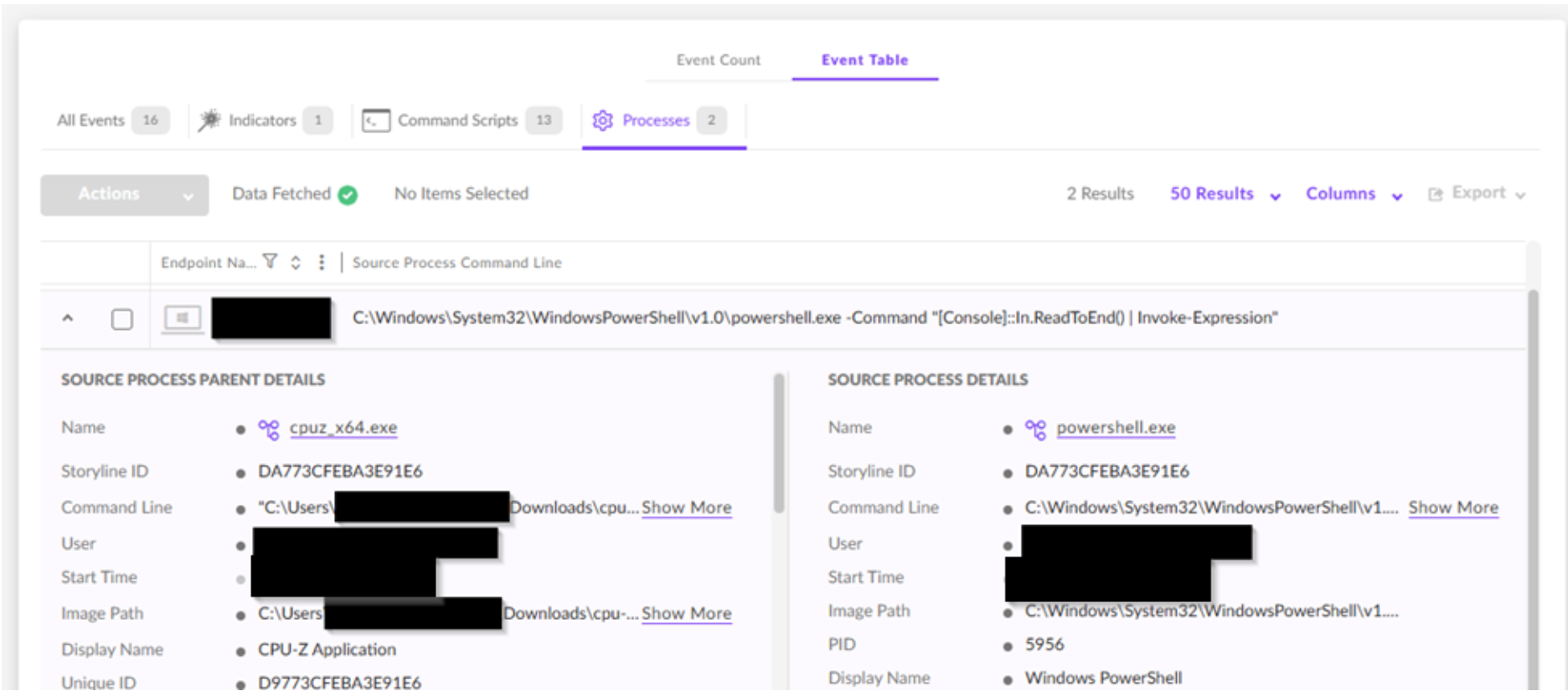
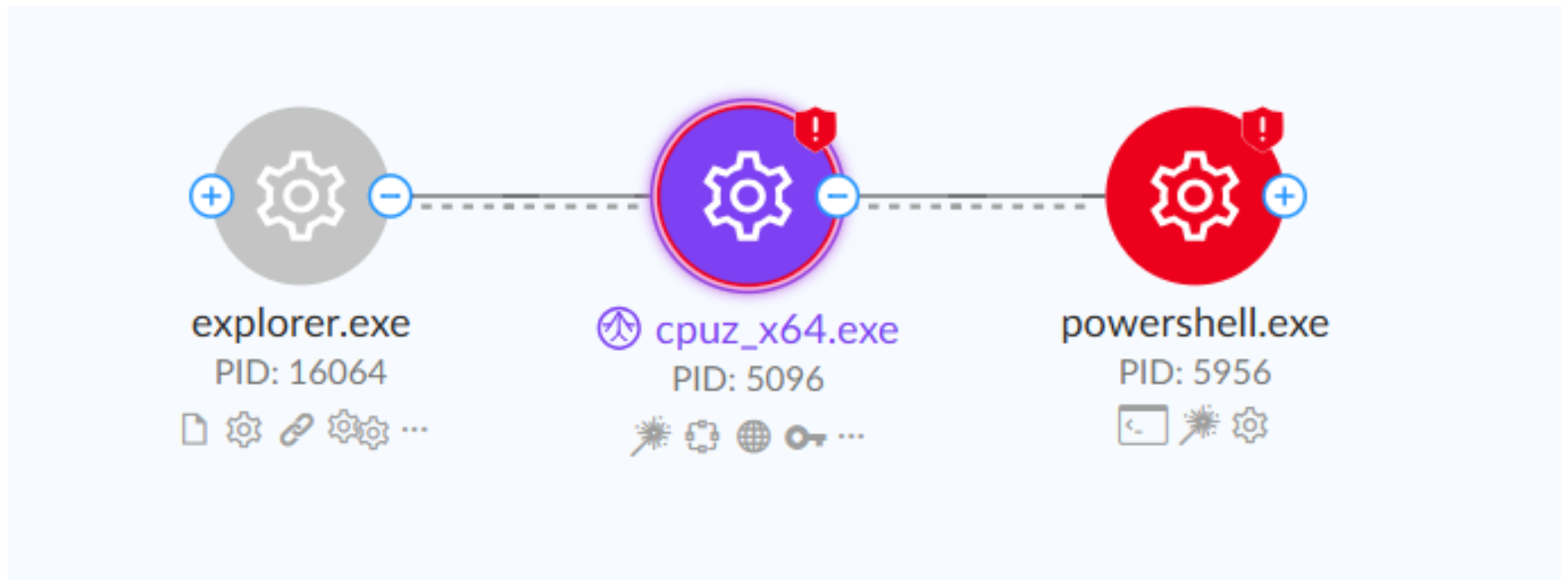
That morning, SentinelOne’s behavioral detection flagged an anomaly inside cpuz_x64.exe. The binary was genuine. The digital signature was valid. The download had arrived from the vendor’s own infrastructure. The process chain cpuz_x64.exe began constructing was the tell: it spawned PowerShell, which spawned csc.exe, which spawned cvtres.exe. CPU-Z does not do that.

CPU-Z, HWMonitor, HWMonitor Pro, and PerfMonitor are staples in IT toolkits. The users who downloaded them followed every instruction they’d been given. The trust chain broke above them. The next attack will work the same way.

SentinelOne’s Annual Threat Report identifies exactly this pattern as a systemic shift: “This [shift] extends deeply into the software supply chain, where the identity of a trusted developer becomes the vector of attack.” In late 2025, we observed the GhostAction campaign, where a compromised GitHub maintainer account pushed malicious workflows to extract secrets. A concurrent phishing attack against a maintainer of popular NPM packages deployed malicious code capable of intercepting cryptocurrency transactions. In each case, the commit logs and push events appeared legitimate because they originated from accounts with valid write access. The identity was verified. The intent had been subverted. The CPUID incident extends this pattern to software distribution itself: the supplier’s download infrastructure became the delivery channel.

What the Agent Saw

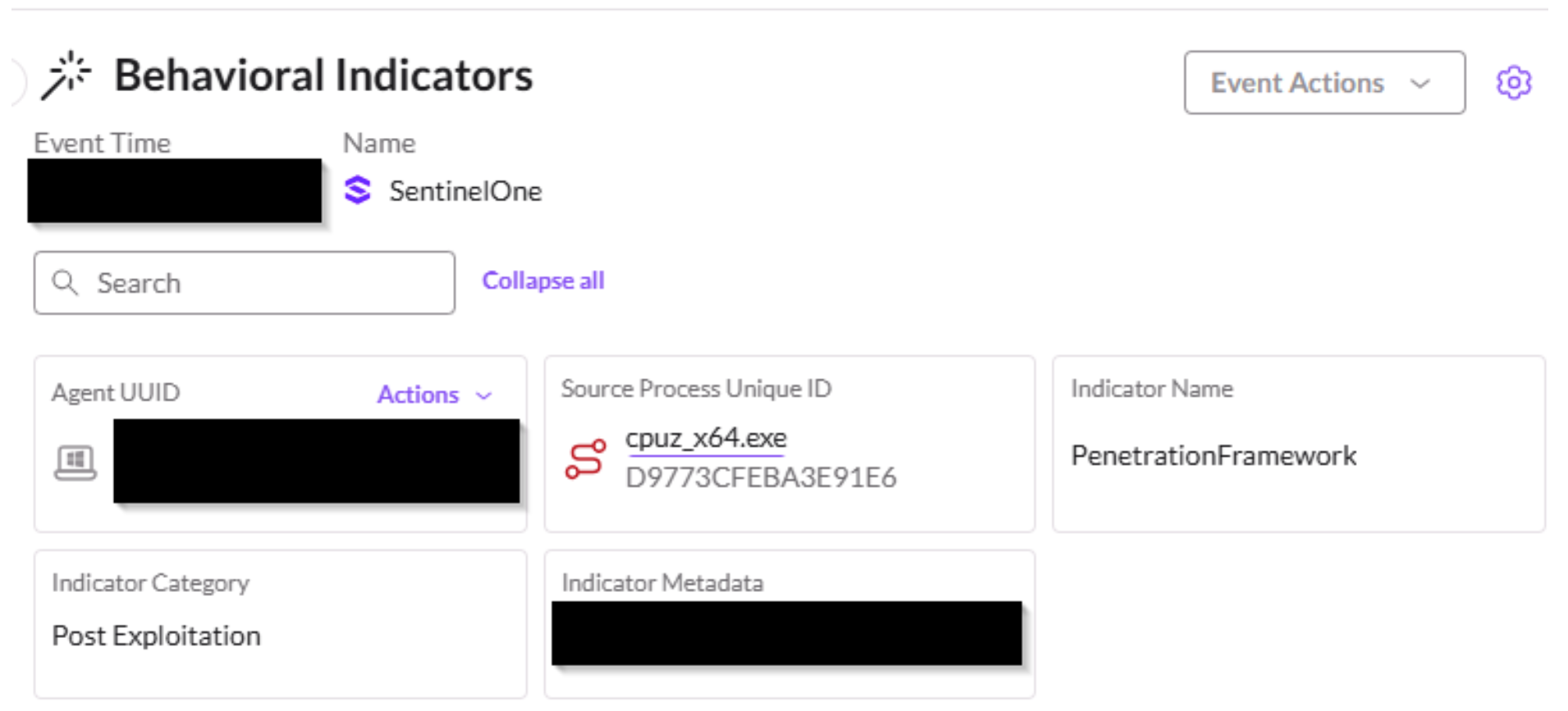
The SentinelOne agent triggered the alert “Penetration framework or shellcode was detected” within the first seconds of execution. The detection came from what the process was doing, with five specific behavioral indicators converging:

  • Anomalous API resolution: The process located system functions through non-standard discovery methods, bypassing the OS loader entirely.
  • Reflective code loading: Executable code was running in memory regions with no corresponding file on disk.
  • Suspicious memory allocation: Read-Write-Execute (RWX) memory permissions were requested, a staging pattern for malicious payloads.
  • Process injection patterns: Execution flow consistent with code being redirected into a secondary process to mask its origin.
  • Heuristic shellcode signatures: Sequential operations characteristic of automated exploitation toolkits preparing an environment for command execution.

The agent autonomously terminated and quarantined the involved processes before the attack advanced further. The malicious CRYPTBASE.dll, placed in the same directory as the legitimate CPU-Z binary, was loaded by Windows before the real system DLL could be reached, and it never completed its job.
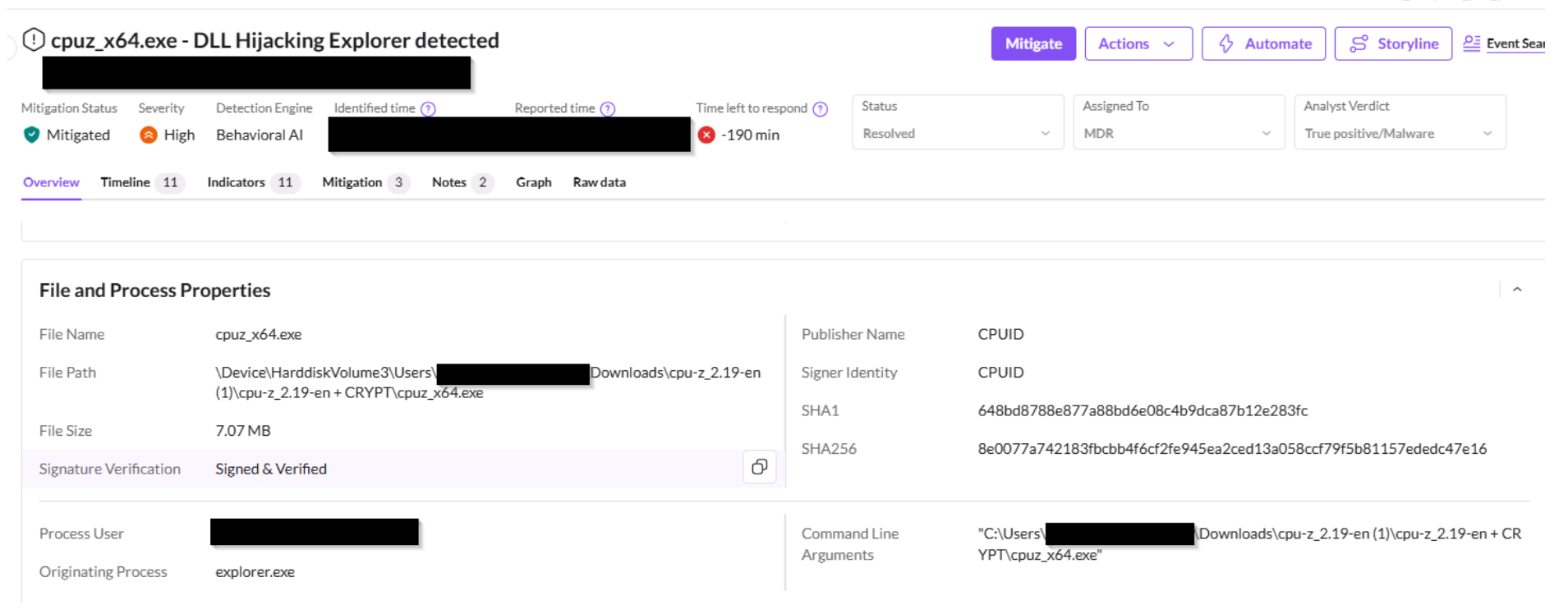
Alert Page
Alert Page

The agent was watching for what the software was trying to do. Behavioral detection is the layer that holds when authorization cannot be trusted, because the behavior reveals intent regardless of what signed the packag
CrowdStrike
Related Product

CrowdStrike Advanced Defend

by CrowdStrike$15.41/mo

CrowdStrike provides advanced cloud-native platform protection for endpoints, cloud workloads, identities, and data with a single lightweight agent.

Learn More
e.

Behavioral Indicator
Process Tree
Process Tree
Event Table
Event Table

What Was Actually Inside

The trojanized packages were designed to leave no trace. A reflective PE loader decrypted and injected a second-stage DLL using XXTEA encryption and DEFLATE decompression, no disk writes, no file artifacts. Three redundant persistence mechanisms were then installed: a registry Run key, a 68-minute scheduled task with a 20-year duration, and MSBuild project files in AppData\Local engineered to survive reboots and partial remediation.

The 2026 Annual Threat Report describes this persistence design as “masquerading as maintenance”: adversaries blend into the environment by mimicking legitimate system updates and background processes. To a busy defender, a scheduled task with a generic name and a timed execution interval appears entirely routine until you examine what it is executing. STX RAT’s 68-minute task with a 20-year duration operates on exactly this logic.

The process chain visible in EDR logs made the intent clear: cpuz_x64.exe spawned powershell.exe, which spawned csc.exe, then cvtres.exe. CPU-Z does not do that.

The final payload, STX RAT, delivered hidden VNC providing an attacker-controlled desktop session invisible to the user, keyboard and mouse injection, browser credential theft across Chrome, Firefox, Edge, and Brave, Windows Vault extraction, cryptocurrency wallet access, and a reverse proxy for follow-on payload delivery. C2 communication ran over a custom encrypted protocol using DNS-over-HTTPS to 1.1.1.1 to bypass DNS monitoring.

A reflective payload executing entirely in memory, inside a signed process, with no disk writes, compresses the detection window to milliseconds. Autonomous response is the only response fast enough.

The Attacker’s Critical Mistake

Kaspersky’s analysis linked the CPUID samples to a March 2026 campaign targeting FileZilla users within hours, and the connection required no advanced forensics. The attacker reused the identical C2 infrastructure and deployed the unmodified STX RAT payload, the same one eSentire’s Threat Response Unit had already fingerprinted and published YARA rules for after the FileZilla campaign.

Those rules detected the CPUID variant without modification.

The actor invested time compromising CPUID’s download API and did nothing to retool after being publicly fingerprinted. The C2 domain, the backend server, the payload: all identical across campaigns. The same backend server had been operating since at least July 2025. Per Kaspersky’s own assessment, the C2 reuse was the gravest mistake of the operation. A more disciplined actor burns infrastructure between campaigns. This one did not, and defenders had working detection before most victims knew an attack had occurred.

What the Attack Was Really For

The 150+ confirmed victims span retail, manufacturing, consulting, telecommunications, and agriculture. The count is almost certainly low, CPUID’s tools have tens of millions of users globally, and the portable ZIP variant of CPU-Z runs commonly on production systems in environments that block installer-based software.

Victim count is secondary to victim profile. CPU-Z users skew toward IT professionals: system administrators, developers, security engineers, the people with domain admin rights, production access, and infrastructure keys. One compromised sysadmin carries a fundamentally different blast radius than one compromised user.

The operational pattern points to an initial access broker. The goal was to sell persistent, hidden access. Someone else would do the extracting.

For organizations where an infection occurred, two questions need answers. What did the attacker do during the window they had access, especially if that machine belonged to a privileged user? And what happens over the next 60-90 days, when whoever purchased that access decides to activate it? Ransomware affiliates who buy IAB access typically move within that window. Cleaning the machine closes one exposure. Monitoring for lateral movement, credential reuse, and unusual authentication in the weeks following remediation closes the other.

SentinelOne
Related Product

SentinelOne Control

by SentinelOne$8.00/mo

Prevention and detection of attacks across all major vectors with fully automated, policy-driven response capabilities and real-time forensics.

Learn More

What Defenders Should Do Now

For practitioners

The indicators are specific and actionable.

  • Check your fleet for CRYPTBASE.dll in any directory other than C:\Windows\System32.
  • Look for the process chain cpuz_x64.exe or any CPUID application spawning PowerShell.
  • Block supp0v3[.]com and 147.45.178.61 at DNS and firewall layers.
  • At the network layer, watch for DNS-over-HTTPS queries to 1.1.1.1/dns-query resolving welcome.supp0v3.com; STX RAT specifically uses DoH to bypass DNS monitoring, and any endpoint generating this pattern is a high-confidence indicator.

If you find an infected machine, remediate all four persistence mechanisms explicitly: the registry Run key, the scheduled task, any MSBuild .proj files in AppData\Local, and PowerShell profile autoruns. The malware installs redundant footholds specifically because partial cleanup leaves it alive.

For security leaders

The harder conversation is about supply chain trust. Your users followed every rule they were given. They downloaded from the official website. They trusted a vendor they had used for years. That vendor’s infrastructure failed them. Behavioral detection, security that watches what software does rather than where it came from, is the layer that caught this.

The business case is specific. When an initial access broker sells a foothold obtained this way, the buyer typically activates within 60-90 days. With average ransomware recovery costs exceeding $4 million per incident, even a single privileged endpoint sold through an IAB represents material, quantifiable exposure. The organizations that already had 24/7 autonomous behavioral monitoring in place closed the window before it opened. The ones that did not are still counting.

The adversary’s tooling was unsophisticated. The OPSEC was poor. The C2 reuse was a gift to defenders. And yet: 150+ confirmed victims and a 19-hour window during which clean, legitimate software was being replaced by a remote access trojan is a demonstration of how far attacker leverage has extended into the software supply chain, and how quickly behavioral detection closes the gap when it acts autonomously, before the attack completes its first stage. The attacker’s poor OPSEC saved defenders this time. The structural failure in the trust model (the assumption that software from a trusted source is safe to run) persists regardless of attacker discipline.

The Structural Problem That Remains

SentinelOne’s latest Annual Threat Report documents GhostAction and the NPM package compromise as supply chain identity attacks through code repositories and package managers. CPUID adds a third layer: the vendor’s distribution infrastructure itself. Across all three cases, access controls validated a legitimate identity. The report frames this plainly: “The identity is verified, but the intent has been subverted, rendering traditional access controls ineffective against the resulting supply chain contamination.”

This shift means authorization, the cornerstone of traditional software trust, is no longer a sufficient security boundary. When the distribution channel becomes the failure point, verification has to move from the point of origin to the point of execution.

In the CPUID case, users followed every rule. They downloaded from the official vendor website. That vendor’s download API was the failure point, compromised at the infrastructure level for 19 hours, with no visible indication.

SentinelOne’s Behavioral AI engine detects suspicious and malicious patterns in real time, watching what the software does regardless of where it came from.

SentinelOne customers were protected through autonomous behavioral detection at the point of execution. The structural failure in the trust model (the assumption that software from a trusted source is safe to run) is a gap that better user behavior cannot close. Behavioral detection at machine speed is what closes it.

To understand how the Singularity™ Platform identifies threats across your environment, including those arriving through trusted software channels, request a demo.

Like this article? Follow us on , , YouTube or to see the content we post.

Book a demo and see the world’s most advanced cybersecurity platform in action.

We are hunters, reversers, exploit developers, & tinkerers shedding light on the vast world of malware, exploits, APTs, & cybercrime across all platforms.

Originally published on April 14, 2026 by Sentinel One.

Expert Analysis for Orange County Businesses

How this impacts SMBs in Southern California

Tech News Roundup: Securing the Software Supply Chain: How SentinelOne’s AI EDR Autonomously Blocked the CPU-Z Watering Hole Cyber Attack

The recent incident involving the CPU-Z watering hole attack serves as a stark reminder of the vulnerabilities present within the software supply chain. For small and medium businesses (SMBs) in Orange County and Southern California, this highlights the critical importance of ensuring that trusted software sources are constantly monitored and secured. Cybercriminals are increasingly leveraging trusted domains to distribute malware, making it essential for local businesses to stay vigilant about their software procurement practices and incident response strategies.

To mitigate risks associated with supply chain attacks, SMBs should consider adopting a comprehensive cybersecurity framework that includes proactive measures such as regular security audits and robust endpoint detection. TNC's managed IT services can provide ongoing monitoring and threat detection to help secure your digital environment. Additionally, our BCDR (Backup and Disaster Recovery) solutions ensure that your critical data is backed up and can be restored swiftly in the event of an attack. By partnering with us, you can enhance your resilience against these evolving threats and focus on growing your business with peace of mind.

Read the full article: Original Source Link

Frequently Asked Questions

What is a watering hole attack?

A watering hole attack targets specific groups by compromising websites they are likely to visit, delivering malware through seemingly legitimate downloads.

How does SentinelOne's AI EDR work?

SentinelOne's AI EDR uses behavioral detection to identify anomalies in software behavior, autonomously blocking potential threats before they execute.

Content Quality

Last Reviewed:May 2, 2026
Fact-Checked:May 2, 2026
Sources:14 verified sources
Word Count:1,819 words

Article Tags

Company
CPU-Z
CPUID
Supply Chain Attack
threat report
SentinelOne
AI EDR
CPU-Z watering hole attack
software supply chain security
cybersecurity threats
malware detection
behavioral analysis
cyber attack prevention
threat intelligence
compromised software
S

About SentinelOne

Content Author

SentinelOne is a leader in autonomous cybersecurity solutions, specializing in advanced threat detection and response. With a focus on AI-driven technologies, they empower organizations to safeguard their digital environments against evolving cyber threats.

Expertise: Cybersecurity, AI-driven threat detection, software supply chain security, malware prevention, incident response

Ready to Transform Your Business?

Discover how our expert IT solutions can help your business thrive.